If SpaceX Stock Falls Below $100, History Suggests This Is the Move to Make Adam Spatacco, The Motley FoolSat, September 12, 2026 at 9:07 AM UTC 0 Image source: The Motley Fool.Key Points Since its public debut in June, SpaceX stock has soared to as much as 50% above its opening trading price, and has also slumped to as far as 30% below it. Analysis of other recent tech IPOs suggests that buying into volatility can eventually pay off for patient investors.
If SpaceX Stock Falls Below $100, History Suggests This Is the Move to Make

Adam Spatacco, The Motley FoolSat, September 12, 2026 at 9:07 AM UTC
0
Image source: The Motley Fool.Key Points -
Since its public debut in June, SpaceX stock has soared to as much as 50% above its opening trading price, and has also slumped to as far as 30% below it.
Analysis of other recent tech IPOs suggests that buying into volatility can eventually pay off for patient investors.
While SpaceX has recovered from its early slump, the company still has a lot to prove before the market will have reason to bid the stock to new highs.
10 stocks we like better than Space Exploration Technologies ›
Elon Musk's Space Exploration Technologies(NASDAQ: SPCX), better known as SpaceX, has already given investors the full IPO experience. SpaceX stock opened on the Nasdaq at $150. In its first few days, shares soared, briefly touching a high of $225.64 -- a pop of roughly 50% in less than a week.
Predictably, momentum traders started cashing out and booking quick gains. Throughout the summer, volatility was the main theme with SpaceX stock. Shares slid as low as $104.83 in early August before gradually climbing back to around their opening price, which is where they're hovering today. That's a lot of volatility.
Missed Nvidia in 2009? This Rare Signal Is Flashing Again.In 2009, a "Double Down" signal flashed for a little-known chipmaker called Nvidia. For the first time in years, that same "Total Conviction" signal is flashing for a company 1/100th the size of Nvidia. Continue »
The question I've been mulling over is a little uncomfortable: If SpaceX stock again crashes, this time to an even deeper low of, say, under $100 per share, should investors treat that event like a gift? Or would it be better to read it as a sign that Musk's empire of reusable rockets, satellite broadband services, and artificial intelligence (AI) is really just a falling knife masked as a once-in-a-generation opportunity?
How have other mega-IPOs played out?
SpaceX went public in the largest IPO in history, raising nearly $86 billion. To put into perspective where the stock could be headed, let's consider three other recent IPOs that attracted major hype: Palantir Technologies(NASDAQ: PLTR), Snowflake(NYSE: SNOW), and Figma(NYSE: FIG).
Palantir's first year as a public company looked like a solid win. The data analytics company went public at $10 per share in September 2020. By the end of that year, the stock had doubled. In late January 2021, shares spiked into the $40 range before giving back some of those gains, eventually settling in a range between $20 and $30 for the rest of the year.
But Palantir spent the next year getting chopped down to a low near $6 per share. It wasn't until the company turned profitable and launched its Artificial Intelligence Platform (AIP) in mid-2023 that institutional investors began respecting it more.
Over the last few years, Palantir has consistently proven it's one of the backbones of enterprise AI systems across the public and private sectors. As a result, both Wall Street and retail investors have come to appreciate it, and have treated the stock as a core beneficiary of the AI revolution.
Snowflake's public debut was hard to miss. In September 2020, Snowflake stock opened trading at $245 and closed its first day of trading at $254. The company's first year on the exchanges was a rocket ride. Shares kept climbing throughout 2021, peaking at $402 by November of that year. But similar to Palantir, Snowflake's valuation collapsed during 2022. By the spring, Snowflake stock had given back its entire post-IPO runup and briefly traded under its IPO price of $120.
The irony is that Snowflake's business was growing the entire time. Yet investors remained skeptical until the AI data-cloud story looked convincingly less like a slogan and more like the product revenue of a hypergrowth company deserving of a premium multiple. Today, Snowflake stock trades around $333, giving it a gain of 36% over six years.
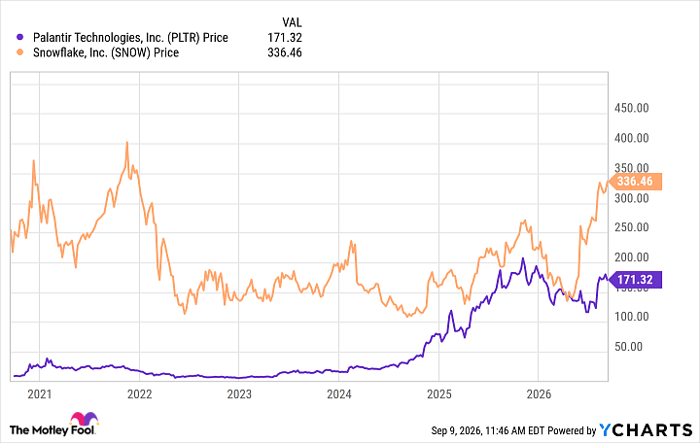
PLTR data by YCharts.
Software-as-a-service company Figma opened on the public exchanges at $85 per share and popped to $115 in its first session. By the next day, Figma stock reached $143. That 68% surge echoes the rise SpaceX stock took in its first days of trading. Unfortunately for those who were chasing momentum, that was the high point. Figma has spent the last year sliding through the $80s, then the $40s, then into the $20s, eventually settling at a low near $17. But just like Snowflake, Figma's revenues have kept growing at rates in the vicinity of 40% throughout that prolonged sell-off.
Advertisement
These three particular IPOs are worth paying attention to because SpaceX has been rhyming with them in its limited time as a public company. The initial pop and the first fade have already happened. To me, a break under $100 per share would simply mean the market has decided that, based on SpaceX's rocket launch cadence, Starlink's economics, and the company's capital-intensive AI infrastructure promises, the valuation the company went public with was too rich.
What can investors learn from IPO investing?
If SpaceX stock falls below $100, the easy take would be that the market is handing you an opportunity to buy the dip. Reflecting on the similar IPOs discussed here shows that this mindset was how many people got stuck buying at the wrong time. Some investors who bought Palantir near $40 in early 2021 watched the stock crater to $6. A Snowflake buyer who go int at $250 on day one and held on would have spent years underwater. Meanwhile, anyone who bought Figma during its first few days and months on the market is either still in the red or has liquidated their position at a considerable loss.
With all that in mind, investors should view the investment thesis for SpaceX in terms of actual numbers, not vibes. Ask yourself: What rocket launch cadence, Starlink cash flow, and AI infrastructure revenue would make a $100 share price actually look cheap for the company instead of merely lower relative to the current premium valuation?
From there, all you'll need to do is watch SpaceX's progress in terms of flight rates, constellation utilization, and whether the AI segment is turning profitable. If those operational metrics improve while the ticker sulks, that is a setup that should eventually pay off. Both Palantir and Snowflake demonstrate that point. On the flip side, if SpaceX's finances stall, then a $99 share price would just be a cheaper way to own the same problem.
The market always follows earnings
If SpaceX follows the same descending path that other mega-IPOs have, history suggests investors should not load up at $99 a share. Instead, reframe the nature of the investment opportunity, keep monitoring earnings, and start buying shares only when the company is achieving what it has set out to do. If rocket launches, Starlink's subscriber numbers, and AI revenue compound while the ticker heads sideways, that is usually when the rerating quietly begins. Markets can be late, but they are not clueless.
This is the difference between buying a story and investing in a business with real earnings. While the initial IPO tape can make a story feel finished, the companies discussed here proved that the offering is only the opening scene. In reality, SpaceX is still in that scene. For now, a sub-$100 price tag would mostly mean that the stock's first pop was where the easy money was made. Now, investors face the harder question of whether the stock is still worth owning on the way down.
Should you buy stock in Space Exploration Technologies right now?
Before you buy stock in Space Exploration Technologies, consider this:
The Motley Fool Stock Advisor analyst team just identified what they believe are the 10 best stocks for investors to buy now… and Space Exploration Technologies wasn’t one of them. The 10 stocks that made the cut could produce monster returns in the coming years.
Consider when Netflix made this list on December 17, 2004... if you invested $1,000 at the time of our recommendation, you’d have $409,917!* Or when Nvidia made this list on April 15, 2005... if you invested $1,000 at the time of our recommendation, you’d have $1,341,724!*
Now, it’s worth noting Stock Advisor’s total average return is 942% — a market-crushing outperformance compared to 211% for the S&P 500. Don't miss the latest top 10 list, available with Stock Advisor, and join an investing community built by individual investors for individual investors.
See the 10 stocks »
*Stock Advisor returns as of September 12, 2026.
Adam Spatacco has positions in Palantir Technologies. The Motley Fool has positions in and recommends Figma, Palantir Technologies, and Snowflake. The Motley Fool has a disclosure policy.
Source: "AOL Money"
Source: Money
Published: September 12, 2026 at 12:18PM on Source: PRIME TIME
#ShowBiz#Sports#Celebrities#Lifestyle