Dan Wolken Senior writer Tue, November 3, 2026 at 3:09 PM UTC · 7 min read About Our Ads Advertisement Advertisement Advertisement If you're reading this prior to Tuesday night, there's a group of men and women who need your thoughts and prayers.
Yes, they may be cloistered in a five-star resort near the Dallas-Fort Worth International Airport. Yes, they may be enjoying catered meals including creamed spinach, cowboy corn and an assorted dessert bar. And yes, they may be wasting their own and everyone else's time by even participating in this project.
But the College Football Playoff selection committee, maybe for the first time in its existence, truly deserves some sympathy.
For most of us, the initial release of playoff rankings is typically an exercise akin to beating your head against a concrete wall. The fake seriousness, the inconsistent logic, the non-answers from the committee chair when you point out obvious flaws in their process? It's all such a silly little routine: Predictable and infuriating, even as we understand it's completely inconsequential at this stage of the season.
This year, though, we need to give these people a break and show a little compassion. Because have you looked at the playoff picture lately?
The 12-team playoff was designed to keep more teams in the mix and raise the stakes of late-season games as the calendar turns to November. It was not intended to be an advanced calculus problem, but here we are.
Given the number of championship-quality teams with two losses, the vast scheduling disparities that exist even between teams in the same conference, much less different leagues, and the quarterback injury factors at schools like UCLA and Ohio State, the picture is about as clear as a Jackson Pollock.
You can interpret what you see pretty much however you want.
Obviously, things will change quickly because this weekend is the most loaded slate of games in recent memory. By the time we're finished with Miami at Notre Dame, Georgia at Ole Miss, BYU at Utah, Kentucky at Tennessee, Alabama at LSU, Texas at Missouri and Iowa at Northwestern, much of the committee's future work will be done for it. By the end of season, if history is any precedent, there will only be a couple tough decisions.
Give these committee members some medals or something just for the effort because sorting out this mess is not a job for the weak.
Solving the puzzle is easy enough at the beginning. Unbeaten Miami is going to be No. 1 and Georgia will be No. 2, which hardly anyone could disagree with. Then we'll probably get Utah at No. 3 because, if this is like past years, the committee will care more about the Utes' 8-0 record rather than a schedule that was front-loaded with some of the weakest teams in the Big 12. Because Utah at least has one good win over Houston, that's not going to be very controversial either.
But once you get beyond that, it's a mosh pit.
Start with an 8-0 UCLA team that has one good win (at Oregon) but an offense that hasn't exactly looked smooth since quarterback Nico Iamaleava went down to a season-ending injury. How can you compare that résumé to, say, 6-2 Texas which has three excellent wins (Ohio State, at Tennessee, Ole Miss) but also two really bad losses to Oklahoma and Florida?
It's impossible because their seasons so far have almost nothing in common that provides a point of comparison. Sure, the committee's got all kinds of data tools and analytics that can help them sort through various components of a team's performance, but ultimately you have to either pick between record and schedule strength. That's not an easy call.
How can you compare 7-1 Notre Dame (beaten nobody of consequence, lost a great game at BYU that came down to one play) to 8-1 Indiana (beaten a slightly better set of teams but has needed a lot of luck to do so, and lost a great game to Ohio State that came down to one play)? That's a tough call.
On résumé, could you give Kentucky (wins over LSU and South Carolina, loss to Alabama) a slight edge over BYU (wins over Notre Dame and Arizona, crazy overtime loss to UCF)? That's a really tough call.
Despite being ranked No. 11 in the AP poll, can you even put 6-2 Ohio State in the bracket after watching the Buckeyes play such awful football at USC last weekend in its first game without quarterback Julian Sayin? Right now, without a timeline for his return due to an arm injury, you almost have to ignore everything Ohio State did for most of September and October.
What do you do with Wake Forest? No, the quality wins aren't there, but boy have they passed the eye test lately. And anyone who watched their 33-20 loss to Miami early in the season would have undoubtedly come away with the impression that the Demon Deacons can hang with the top teams in the country.
We've already mentioned 10 teams in this little exercise without even getting to the two-loss SEC teams like Alabama, Texas, Ole Miss, Tennessee and LSU, whose fan bases will be screaming bloody murder if they aren't in the rankings Tuesday night because of the new nine-game Ess-Eee-See schedule that seems to be creating a totally new level of parity in the league.
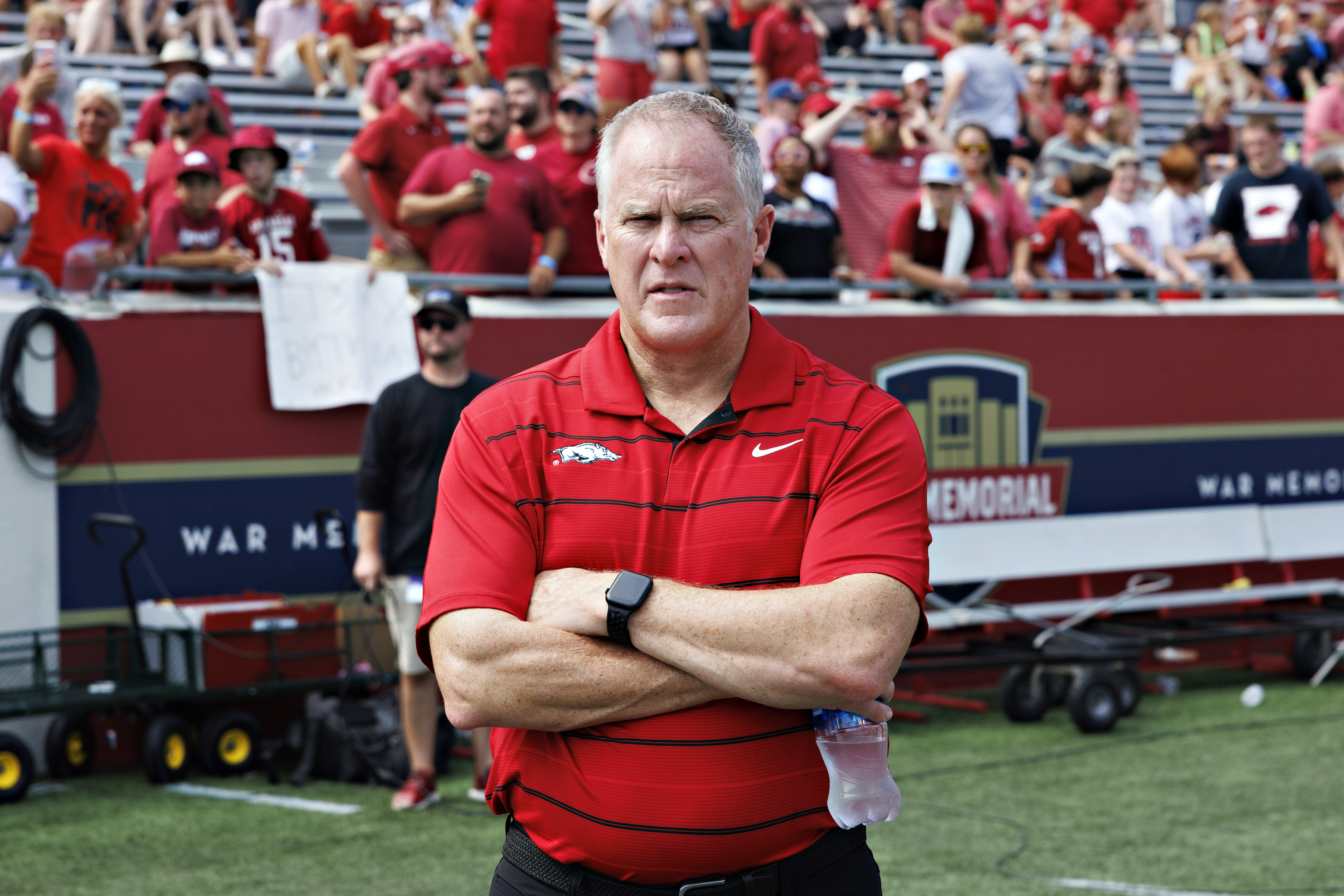
Arkansas AD Hunter Yurachek is the spokesman for the College Football Playoff selection committee. (Wesley Hitt/Getty Images)
It's a true "choose your own adventure" situation, with all roads leading to a bottle of Advil.
Poor Hunter Yurachek. Back home, the Arkansas athletic director has been on the hot seat so long thanks to the Razorbacks' football follies that his backside has turned a permanent shade of magenta. Now, even when he gets out of town for a long weekend of committee work, he goes right from the fryer to the frying pan.
This man's job is to go on national television and pretend like this process is ironclad, knowing quite well that no matter what ranking his committee spits out, there is no chance of being able to defend it coherently.
We play this game even in the easy years, and it always turns out the same: When someone asks why the committee picks Team A over Team B, Yurachek (or whoever happens to chair the committee) will give an answer using a particular data point or head-to-head result. Then he'll get asked why the committee picked Team X over Team Y and the same principle he just cited will go out the window and he's got to sit there and act like it all makes sense.
So in addition to getting yelled at by his own fans and media members for his regular job, he'll also get yelled at on social media by thousands of people who would otherwise have no idea who he is. Sounds like a blast.
It's enough to make you wonder why these otherwise busy athletic directors, who are under more pressure than ever on their own campuses, would sign up to be on this committee in the first place. Is the creamed spinach really that good?
Of course it's not. But it is a big ego trip with a lot of fun perks, and the job seems easy enough. Since the first year of the playoff, there have only been three real controversial decisions at the end: Ohio State over TCU at Baylor in 2014, Alabama over Florida State in 2023 and Miami over Notre Dame last year. And the only one of those three that truly seemed unjust was the FSU snub, which only happened because the Seminoles lost quarterback Jordan Travis to injury late in the season and were evaluated on a two-game sample with their backup.
So yes, it's a big time commitment for committee members to fly down to Texas and do these fake rankings for ESPN's benefit, but it's not exactly been a hard job.
Now the bill has come due, and they have real, thankless work to do. Hopefully the dessert bar will be worth the aggravation.
Source: Sports



0 Comments